5.4. AI for Productivity and Personal Life
Jennifer Martin
Artificial intelligence has moved into the background of everyday routines. It can draft emails, tidy meeting notes, outline proposals, build study plans, suggest recipes, and nudge us to stick with new habits. The value is not in replacing judgment, but in reducing routine load so attention can shift toward planning, problem solving, and relationships. Studies continue to track these effects as they evolve; for example, recent HBR research reports measurable productivity gains alongside motivation tradeoffs, and follow-up analysis explores how teams spend the time they save.
AI in Professional Productivity
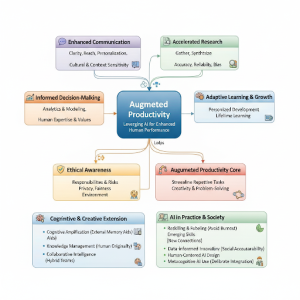
At work, AI often supports tasks that are repeatable yet require attention to detail. A faculty member might request a first-pass summary of a committee meeting, then revise it to match the official record and outline next steps. An administrator might transform raw notes into a draft project plan, then refine timelines, responsibilities, and risks. These examples reflect broader workplace trends in which workers increasingly use AI to manage information load and workflow demands, as noted in the Microsoft Work Trend Index and related survey data on adoption and habits.
Sound practice treats AI as a junior assistant: helpful for getting started, but limited in context and judgment. Always review for accuracy, ensure the tone fits your institutional voice, and confirm that facts, figures, and interpretations are correct. For sensitive or confidential work, use institutionally approved tools and settings.
AI in Personal Life
Outside of work, the same ideas apply. Learners use AI to build study schedules, quiz themselves, or translate a tough reading into plainer language. Families experiment with meal planning and travel itineraries that respect budget, time, and constraints. Individuals try journaling prompts or habit trackers that provide a gentle structure. These supports are helpful as long as final choices reflect personal needs and professional advice where relevant. A plan generated by AI is a starting point, not a prescription.
Here are some example prompts for using AI in your personal life:
- Prompt – Professional Email Drafting
- “Write a professional email to faculty reminding them of the upcoming deadline for annual reports. Keep the tone respectful, clear, and concise. Include a bulleted list of required items and the due date.”
- Prompt – Meeting Summaries
- “Summarize the following meeting transcript into a bulleted action summary for our department. Identify key decisions, responsible parties, and next steps.”
- Prompt – Form or Policy Draft
- “Draft a first version of a student leave-of-absence request form for a health professions program. Include required fields and short policy notes explaining documentation needs.”
- Prompt – Task Prioritization
- “List my tasks for today: [paste list]. Sort them by urgency and importance using the Eisenhower Matrix and suggest one way to automate or delegate each.”
- Prompt – Grant Abstract Simplification
- “Rephrase this grant abstract for a general audience such as a community advisory board. Keep key details but make it readable at a Grade 9 level.”
- Prompt – Reflective Professional Practice
- “Generate 3 reflective questions faculty could use to evaluate their responsible use of AI in teaching, research, and service.”
📖 Analogy: Power-Assist Bicycle (click to expand)
Using AI for daily productivity is like riding a power-assist bicycle. You still steer, balance, and choose the route, but the assist helps you climb hills and arrive with energy to spare. In the same way, AI helps with repetitive tasks so you can invest more attention in creativity, relationships, and higher-order decision-making.
Guardrails for Quality and Trust
- Verify before you send or share. Review tone, accuracy, and sources. If a claim matters, confirm it.
- Protect privacy. Do not paste confidential or student data into public tools. Use approved platforms for sensitive work.
- Disclose when appropriate. If AI materially shaped a deliverable, say how you used it. This builds trust and models integrity.
- Be intentional with the time you save. Redirect minutes gained toward deeper work or student support. See the discussion in HBR on time reallocation.
Video: Practical Skills for Everyday Productivity
For a concise, skills-oriented overview, watch this short segment from Google’s AI Essentials that focuses on using AI for everyday tasks and decision-making:
Further Reading
- HBR: Boost Your Productivity with Generative AI (practical strategies and pitfalls)
- Microsoft WorkLab: Work Trend Index (global adoption and behavior patterns)
- TWU LinkedIn Learning (How to Boost Your Productivity with AI Tools [50 minutes]; Boosting Your Time Management with AI Tools [40 minutes])
Personal Life Prompts For Fun
- Daily Planner
- “Create a balanced daily schedule for me that includes work, exercise, dinner, and downtime. I want to finish by 9 p.m.”
- Meal Planning
- “Plan four healthy dinners this week using chicken, beans, and vegetables. Provide a grocery list and prep tips.”
- Budget Helper
- “Help me plan a monthly budget for $4,000 take-home pay. Include essentials, savings, and one small indulgence.”
- Declutter Challenge
- “Create a 7-day home decluttering challenge that only takes 20 minutes per day.”
- Mindfulness Moments
- “Give me a 2-minute mindfulness script I can use before class to refocus.”
- Exercise Ideas
- “Design a 20-minute stretching routine I can do between meetings at my desk.”
- Healthy Habits Tracker
- “Help me create a weekly self-care tracker with hydration, sleep, and movement goals.”
- Motivation Messages
- “Generate a short motivational quote for healthcare educators balancing research, teaching, and life.”
- Values Clarification
- “Ask me five reflective questions to help identify my core personal values.”
- Gratitude Practice
- “Help me write a brief gratitude journal entry for today focusing on one small positive moment.”
- Goal Reflection
- “Guide me through reflecting on one goal I accomplished this month—what helped me succeed?”
📚 Weekly Reflection Journal
Reflection Prompt: Choose one routine you actually manage, such as email, scheduling, studying, budgeting, or wellness tracking. Where could AI reduce load without reducing quality? Write one benefit and one risk, and name one guardrail you will follow.
Looking Ahead
Next, in 5.5 Applied Challenges, you will test these ideas in short, hands-on exercises and compare approaches with peers.